


Anne Wölk Inspires Cosmic Wonder Through the Language of Light and Color
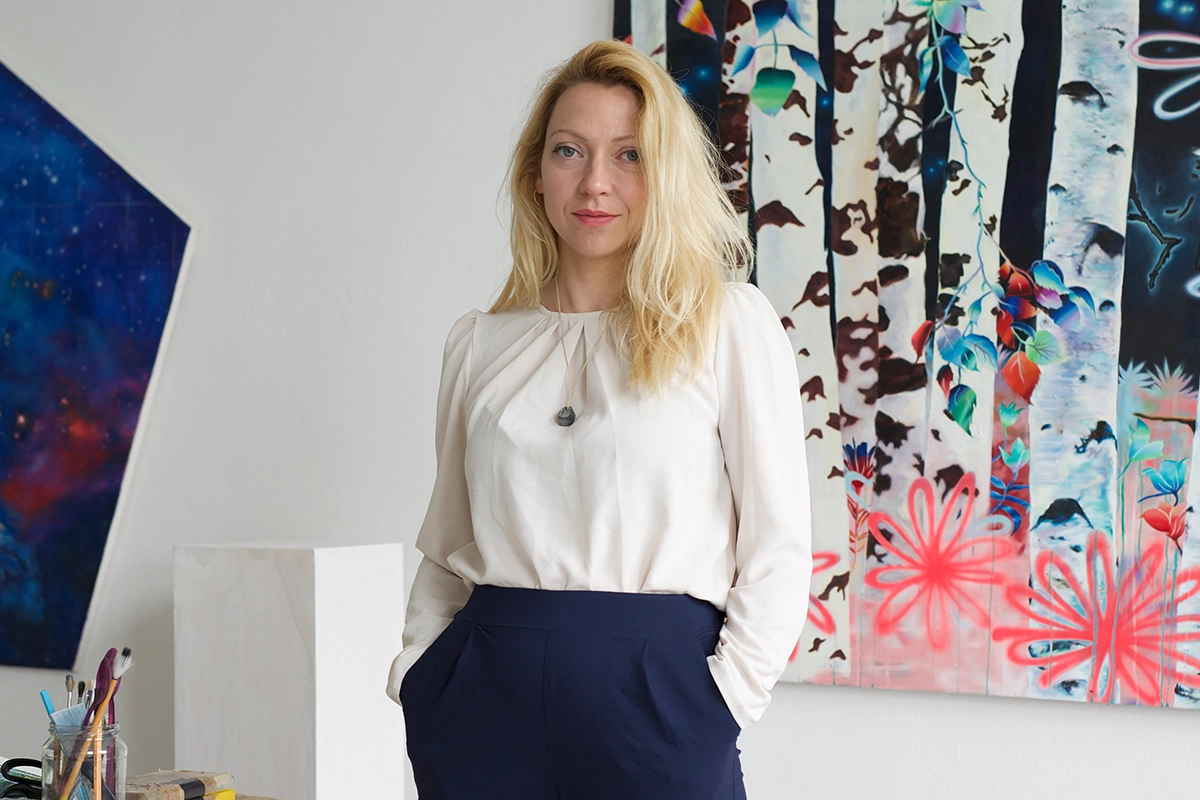
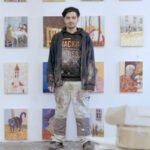
Anne Wölk pictured in her Berlin studio, where timeless tradition meets cutting-edge imagination to craft her breathtaking cosmic landscapes.
Exploring the Universe Through Painting That Combines Tradition, Digital Culture, And Endless Imagination
Anne Wölk’s art merges Romanticism, digital aesthetics, and scientific curiosity, creating captivating cosmic narratives that reflect humanity’s longing for connection, existence, and the imaginative futures projected beyond Earth’s boundaries.
A nne Wölk’s artistic journey is nothing short of extraordinary, a testament to her boundless imagination and intellectual rigor. A Berlin-based painter with a cosmological vision, Wölk bridges the gap between the tactile traditions of classical painting and the futuristic complexity of digital aesthetics. Her work transcends the canvas, creating immersive landscapes that invite viewers to contemplate humanity’s place within the vast expanse of the universe.
With an academic foundation built at the prestigious Chelsea College of Art and Design in London and The School of Art and Design Berlin, Wölk’s practice reflects a deep integration of philosophy, astronomy, and media theory. Yet, what truly sets her apart is her ability to weave the sublime beauty of Romanticism with the pixelated textures of the digital age. Her cosmic landscapes are not merely representations; they are coded environments where light becomes data, color becomes emotion, and the boundaries between the real and the speculative dissolve.
Wölk’s dedication to her craft has led her to remarkable feats, from institutional solo exhibitions that explore celestial inquiry to the historic achievement of sending her artwork, Churyumov Gerasimenko, to the lunar surface. Her paintings are as scientifically curious as they are philosophically profound, offering a poetic meditation on existence, interconnectivity, and collective responsibility.
Anne Wölk’s visionary art redefines cosmic landscapes, combining masterful technique with groundbreaking concepts, bridging tradition with the infinite possibilities of innovation.
Through this conversation, we delve into Anne Wölk’s visionary approach, her exploration of humanity’s longing for cosmic connection, and her ability to translate complex digital phenomena into timeless, luminous art. Her perspective is as inspiring as her creations, a vibrant reminder of how art continues to shape our understanding of the universe.
Your work incorporates techniques of old masters but also references modern technologies and digital culture. How do you navigate the balance between tradition and innovation in your creative process?
I see tradition and innovation as two parallel systems of knowledge. Classical oil techniques give me a tactile grounding—an embodied sense of time, materiality, and continuity. Digital culture, by contrast, shapes how we process images today: through screens, algorithms, and unstable resolutions. My process merges these frameworks by treating painting as a hybrid visual language. I use traditional glazing and layered luminosity while absorbing the chromattic logic of digital artifacts and spectral gradients. The result is a dialogue between historical craftsmanship and contemporary modes of perception.
Many of your paintings explore themes of interstellar dust, starscapes, and planetary systems. What inspired your fascination with the cosmos, and how has it shaped your artistic vision?
My fascination began with childhood nights under rural skies, where the absence of artificial light created an almost mythic sense of scale. Later, scientific imagery from observatories and space missions revealed the cosmos as both data and poetry. This duality shaped my vision: the universe becomes a metaphor for longing and a structure for contemplating the fragile systems that sustain us. Painting the cosmos allows me to approach questions of orientation, existence, and the imaginative futures we project into the void.
Your compositions are influenced by Romanticism and Photorealism, yet you subvert traditional methods through conceptual depictions of light and color. Could you elaborate on this approach and how it defines your unique style?
Romanticism informs the emotive atmosphere of my work—the sublime, the ungraspable, the desire to transcend the visible. Photorealism provides formal precision and an attention to the photographic moment. I subvert these traditions by treating light as encoded information rather than natural illumination. Colors often mimic sensor-based readings, digital glitches, or wavelength data. This shifts the meaning of the landscape: instead of representing reality, it becomes a coded environment where perception, technology, and imagination intersect.
How has your time studying at Chelsea College of Art and Design in London and The School of Art and Design Berlin influenced your artistic journey and professional career?
Chelsea encouraged an intellectually rigorous, research-driven approach to practice. London’s cultural density exposed me to critical debates that challenged my assumptions about image-making. Berlin, with its raw immediacy and layered history, grounded my commitment to painting as both a conceptual and emotional medium. These two contexts shaped how I navigate institutional structures, articulate my ideas, and situate my work within global conversations in contemporary art.
Your art often references digital photographic mediums, capturing elements like aberrations, digital gaps, and compression artifacts. Can you explain the conceptual significance of these visual elements in your work?
These artifacts reveal the hidden structure of digital images—the glitches, losses, and algorithmic decisions that shape contemporary vision. They function as ruptures in the illusion of seamless perception. By translating these disruptions into analogue painting, I question how images assert truth or authority. Conceptually, they speak to the instability of knowledge in an era shaped by surveillance, data compression, and infinite reproduction. They also underscore the tension between human touch and technological mediation.
In both your institutional solo shows, “Questions for Heaven” and “The Island of Stars We Call Home,” what were the key messages or themes you hoped to convey to viewers?
Questions for Heaven explored the sky as a space of inquiry—spiritual, scientific, and existential. It positioned celestial observation as a human attempt to negotiate uncertainty. The Island of Stars We Call Home centered on cosmic ecology, inviting viewers to consider Earth as one temporary node within vast stellar processes. Together, the exhibitions examined how we construct meaning when confronted with the magnitude of the universe, and how cosmic thinking can reshape our sense of responsibility toward our planet.
You’ve exhibited your work globally, from Seoul to Miami. How has the exposure to such diverse art communities and cultures influenced your creative process or the reception of your work?
Working internationally revealed how images resonate differently across cultural contexts. In Seoul, viewers connected strongly to the technological and speculative elements. In Miami, the atmospheric and emotional dimensions became more prominent. These variations expanded my understanding of how cosmological themes intersect with local perspectives. They also broadened my visual vocabulary, influencing color choices, compositional strategies, and conceptual questions in subsequent works.
You recently mentioned your drawing “Churyumov Gerasimenko” being sent to the moon as part of a space program. How does it feel to have your art play a role in such a groundbreaking initiative?
It is profoundly moving to imagine a drawing created through human touch traveling beyond Earth. The project symbolizes the continuity of cultural memory and our shared desire to leave traces of ourselves in the cosmos. It reaffirms the interconnectedness of artistic and scientific exploration—both are attempts to understand our place within a much larger narrative.
Can you discuss your experience of exhibiting alongside influential artists like Robert Rauschenberg, Cindy Sherman, and Stephan Balkenhol? What impact, if any, has this had on your career?
Exhibiting alongside such influential figures situates my work within a lineage of experimentation across media, photography, and postmodern critique. These experiences strengthened institutional recognition and opened new professional opportunities. More personally, they affirmed the relevance of painting as a medium capable of engaging contemporary dialogues shaped by technology, identity, and global culture.
With subjects like LED light beams, terraforming colonies, and space stations appearing in your paintings, how do you see your work contributing to the dialogue around humanity’s search for a connection with the universe and speculative futures?
These motifs operate as visual hypotheses—imaginative structures for future human environments. They ask what forms of belonging, ethics, and identity might emerge beyond Earth. By blending scientific speculation with poetic narrative, my work suggests that our search for cosmic connection is simultaneously a search for self-understanding. I hope the paintings encourage viewers to think critically about the futures we envision and the responsibilities embedded within them.