
Sofiia Yesakova Uses the Language of Order to Confront Violence
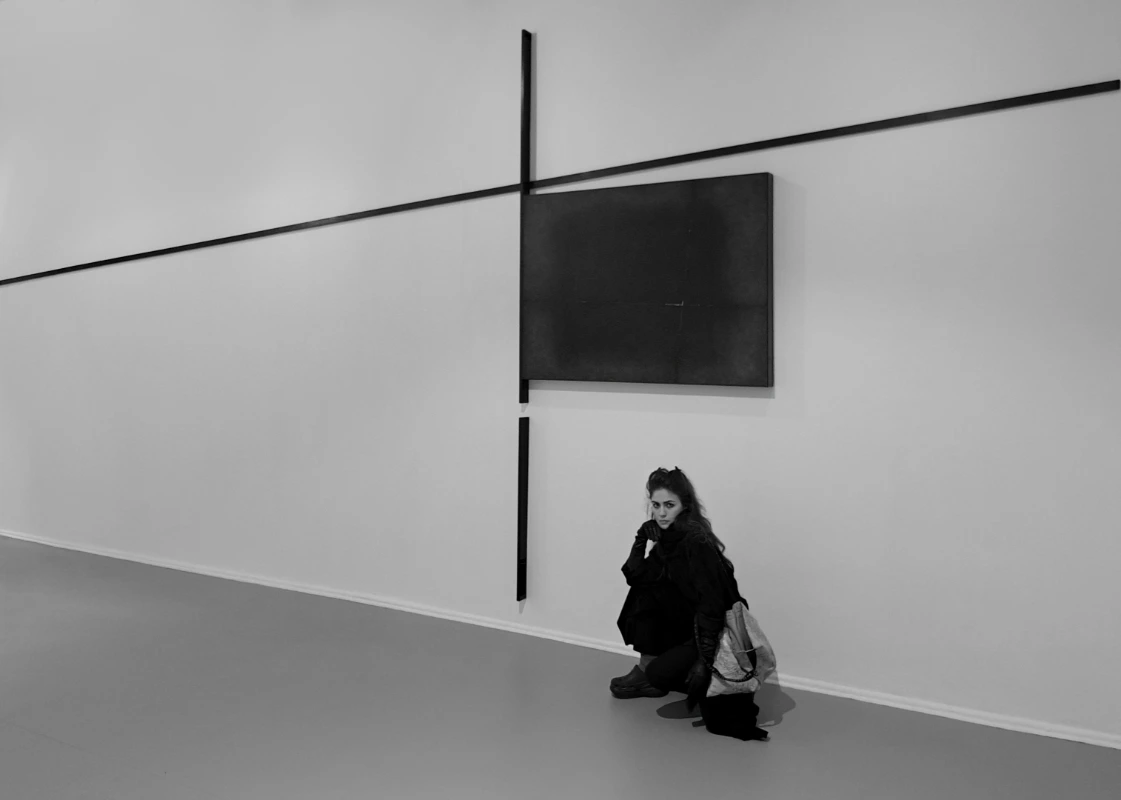
The Human Cost of a Precise Line
Sofiia Yesakova discusses how diagrams, religious symbols and minimalist forms expose systems of violence, balancing emotion with analysis while reflecting on artistic community, philosophical influences and her experience of war.
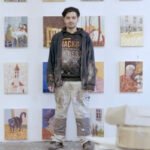
Sofiia Yesakova gives the cool language of diagrams an unsettling human charge. Born in Kyiv in 1998 and based in Berlin, the artist works across painting, relief and installation, drawing on a training in monumental painting at the National Academy of Fine Arts and Architecture in Kyiv. Wood, gesso and layered surfaces become instruments for examining how systems organise experience—and how easily a life can disappear into a number.
Her achievement lies in making formal restraint feel ethically urgent. The spare line, the repeated cross and the schematic image are never merely decorative. They ask viewers to consider the distance between an orderly representation and the suffering it contains. In Cargo 200 and Ugly Scenes. Nuances., the tension between elegance and violence becomes especially searching.
In this interview, Yesakova reflects on professional community, philosophical influences and the difficult relationship between emotion and analysis. Her thoughtful answers reveal an artist committed to holding complexity in view: resisting spectacle while refusing indifference. That combination of conceptual discipline and emotional seriousness gives her practice its distinctive force.
Interview Highlights
- Diagrams reveal how systems reduce people to data.
- Emotion and analysis remain in deliberate tension.
- Religious symbols connect histories of sacrifice and violence.
- Minimalist forms invite a slower, more critical reading.
- Professional community strengthens an independent practice.
How did your year with Goldrausch shape your confidence and professional community in Germany?
The year spent in the Goldrausch helped me to feel more confident in the German art scene. I met many artists and curators, which broadened and strengthened my connections in the professional community. Sharing experiences with colleagues answered many questions that had previously remained open and helped me to better understand the grant system and financial intricacies.
Your work often incorporates diagrams and schematic drawings. Can you explain how these forms help convey the themes of control, regulation, and the search for truth in your art?
The schemas I intentionally use in my works help to take a rational view of the situation, but also with this they point to a bureaucratic view of data. They simplify and depersonalise complex human stories into manageable and standardised elements. In my series of works Cargo 200, dead people are depicted as an endless list without names, sometimes as a number or a formal, schematic coffin drawn from an overhead perspective. This style is reminiscent of blueprints, devoid of life and empathy but conveying functionality, much like the blueprints of concentration camps where every element was rationalised for the sake of efficiency. My visual language here is the language of documentation and accountability, where there is no room for emotion or compassion. In these drawings and diagrams, we see a bureaucratic systematisation of human destinies, where each body becomes an object drawn on the surface.
“In these drawings and diagrams, we see a bureaucratic systematisation of human destinies, where each body becomes an object drawn on the surface.”
Sofiia Yesakova
You make references to philosophers like Gilles Deleuze, Jacques Lacan, and Giorgio Agamben in your work. How do their concepts shape your approach to understanding the relationship between society and the individual?
In his multilevel approach, Deleuze seeks to move away from the traditional Western understanding of logic as a linear, sequential and deterministic process. Instead, he proposes to view thinking as a network, an interweaving of different levels where elements interact and form new concepts. I refer to this idea in my series of works, "Ugly Scenes. Nuances."
I also use one of the most important Lacanian concepts – the symbolic order. Lacan argues that society and language shape and structure our thinking and our self. These systems control our behaviour, desires and identity.
In thinking about mobilisation, I turn to Agamben's theory of biopolitics. The state, he argues, governs populations by excluding and including people in spaces of law and citizenship, which allows it to control not only behaviour but also physical existence. A key example is the state of emergency, where laws can be suspended, and some people are excluded from the political order. According to Agamben, biopolitical power does not simply control civil life, but seeks absolute control over life itself, establishing boundaries beyond which the individual is ‘disenfranchised’.
The tension between emotionality and rationality is central to your work. How do you navigate this balance in your creative process, particularly when responding to political or social situations?
The emotional in my works draws attention to recurring injustice and suffering. The rational is restrained and relies on logic, analysis and symbolic structures to convey social or political messages, encouraging reflection and critical reflection and analysis. The complex multiple meanings of the images form a balance. This synthesis allows the works to be both affecting and thought provoking.
“This synthesis allows the works to be both affecting and thought provoking.”
Sofiia Yesakova
Your art often blends religious symbolism with minimalism and engineering aesthetics. What draws you to these seemingly contrasting elements, and how do you use them to comment on contemporary issues?
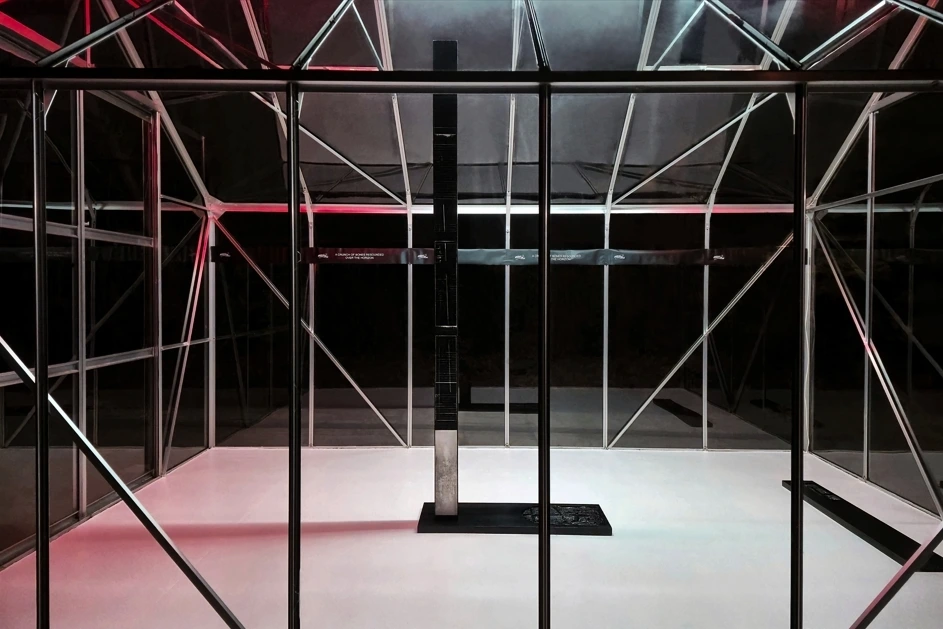
Traditional temple aesthetics details are combined with the elegance of clean lines of wooden slats and emptiness. Minimalism allows for a heightened perception of symbols, and through their repetition, to create a sense of cyclicality, often associated with historical processes and violence. For example, the cross as a minimalist composition of two intersecting lines embodies not only Christian symbolism, but can also symbolise an intersection, a point of return or, for example, the ‘place’ of sacrifice and suffering repeated in human history.
Aesthetics inspired by drawings and diagrams emphasise a rigorous, dispassionate logic suitable for showing systemic manifestations of violence. The drawings often utilise thin lines and empty space, giving the viewer a sense of detached, almost scientific view of the problem.
You mentioned that the depiction of drone targets and explosions in your work can be seen as a modern interpretation of sacrifice. Could you expand on how this symbolism relates to your personal experiences, especially during the conflict in Ukraine?
Religion is quite important in my family, even though I am not a religious person. I also studied at the Faculty of Monumental and Temple Art in Kiev. I use the recurring motif of the cross or the military drone in minimalist form to express not only the Christian idea of sacrifice, but also the idea of cyclical violence, which, like the cross, becomes an "eternal" symbol. This parallel opens new horizons for conceptualisation by linking technological warfare and ancient symbols. They can be used to visualise how violence and sacrifice are intertwined. The target on the drone's screen, as a symbol, embodies a modern understanding of remote violence, where victim and perpetrator are separated by technology and the attack occurs without personal involvement or empathy.
Five Facts About the Artist
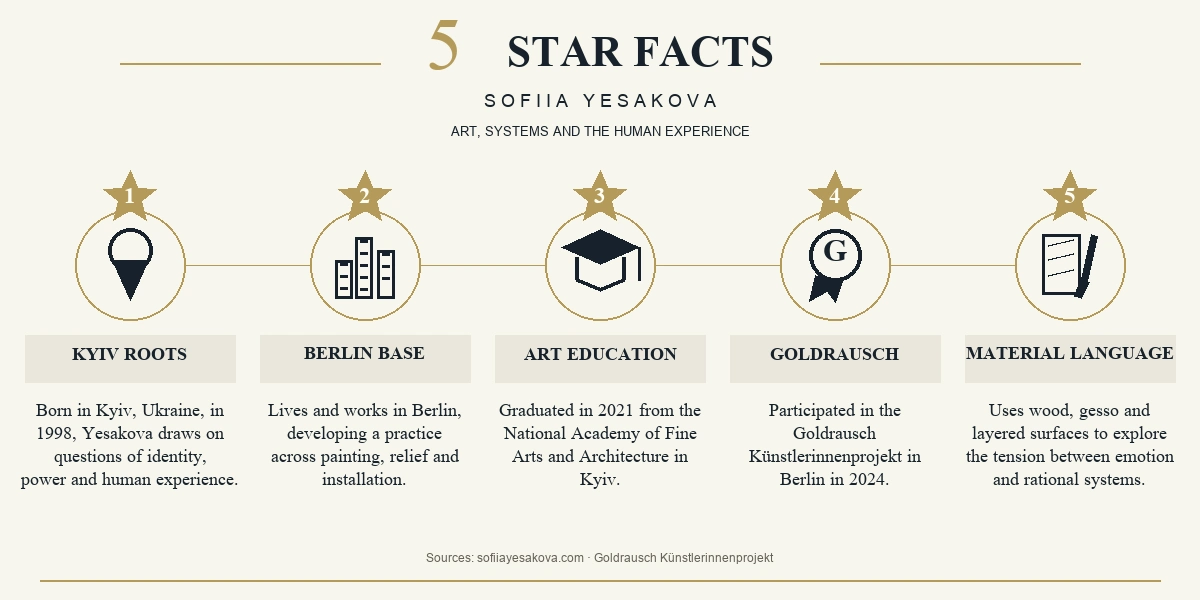
Biographical details verified against the artist’s official website and her Goldrausch profile.
From the Editorial Desk
Editor’s Note
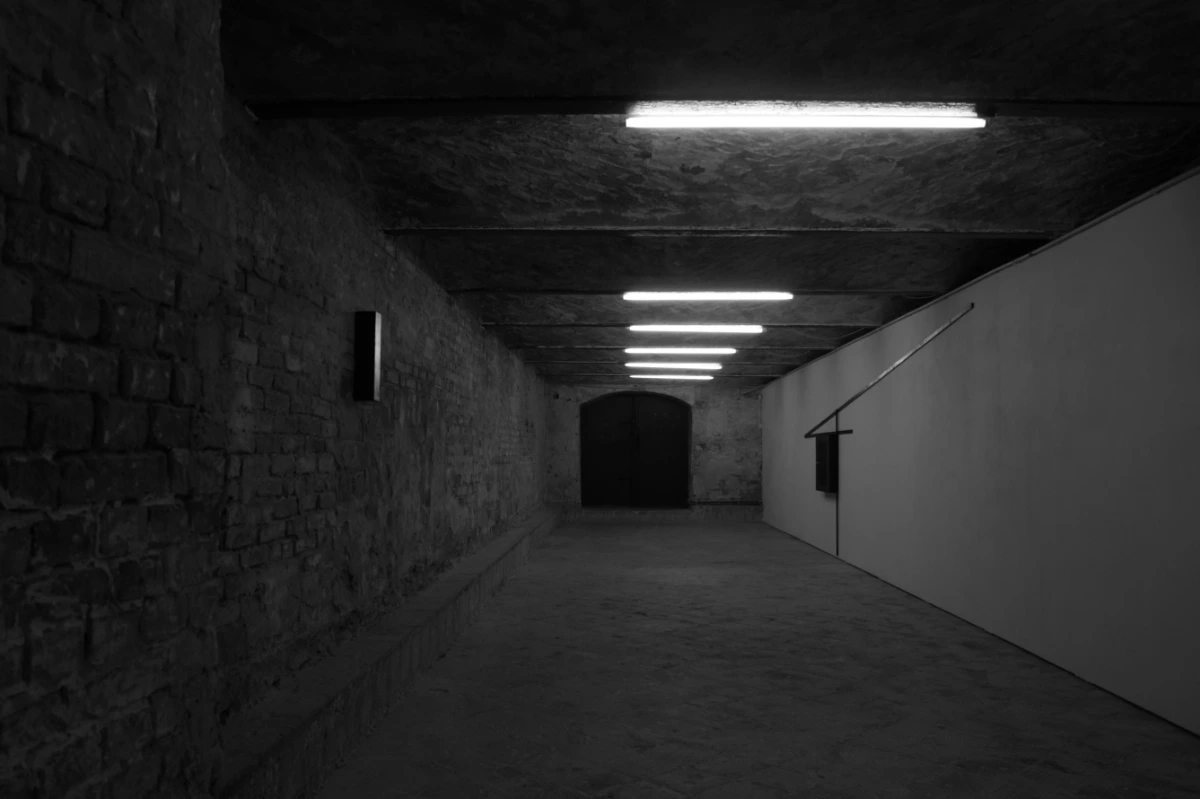
Yesakova’s work is compelling because it refuses an easy division between beauty and discomfort. The precision of her forms invites sustained looking; their implications make that attention consequential. Her use of diagrams and repeated symbols offers a lucid way to question the structures through which violence becomes routine or remote. Particularly impressive is her willingness to keep emotion present within an apparently impersonal visual language. Rather than prescribing a single response, she gives viewers space to recognise their own position. It is a rigorous, thoughtful practice whose quiet surfaces carry a powerful insistence on human consequence.
Explore Sofiia Yesakova’s work.