

Danja Akulin Explores Light And Shadow Through Compelling Contemporary Drawings
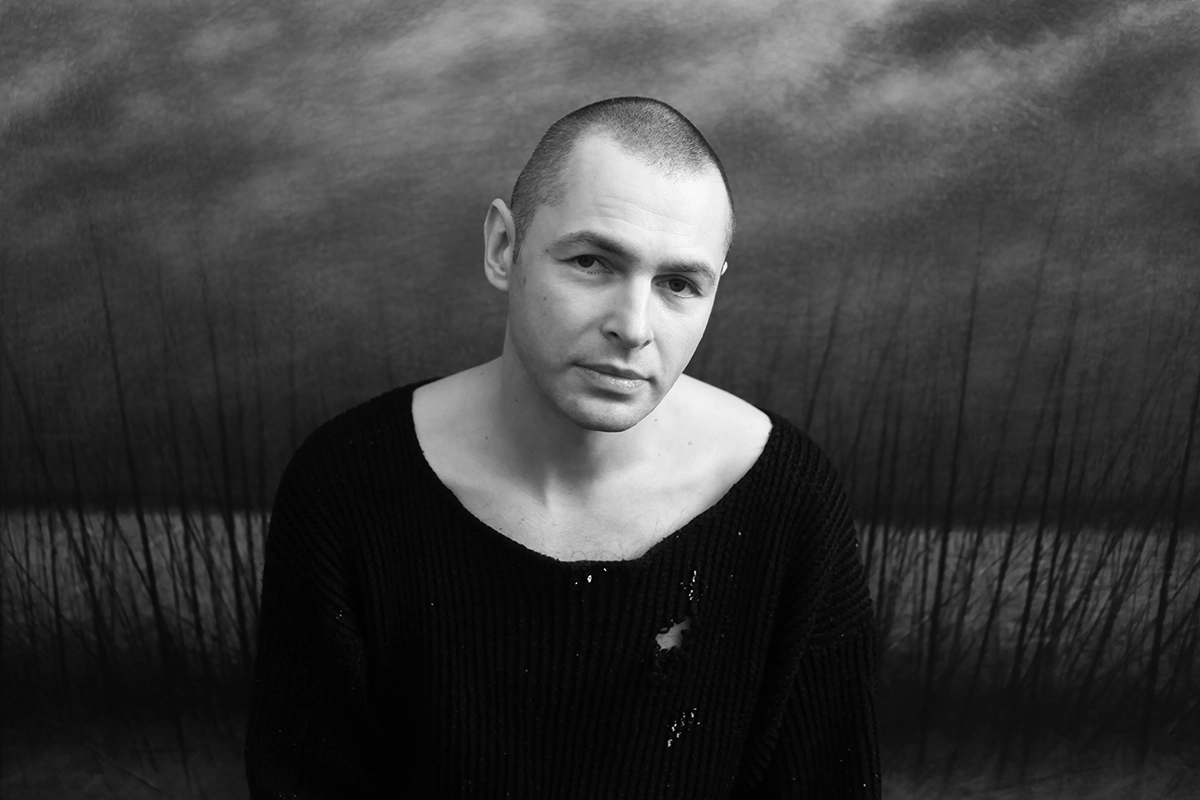
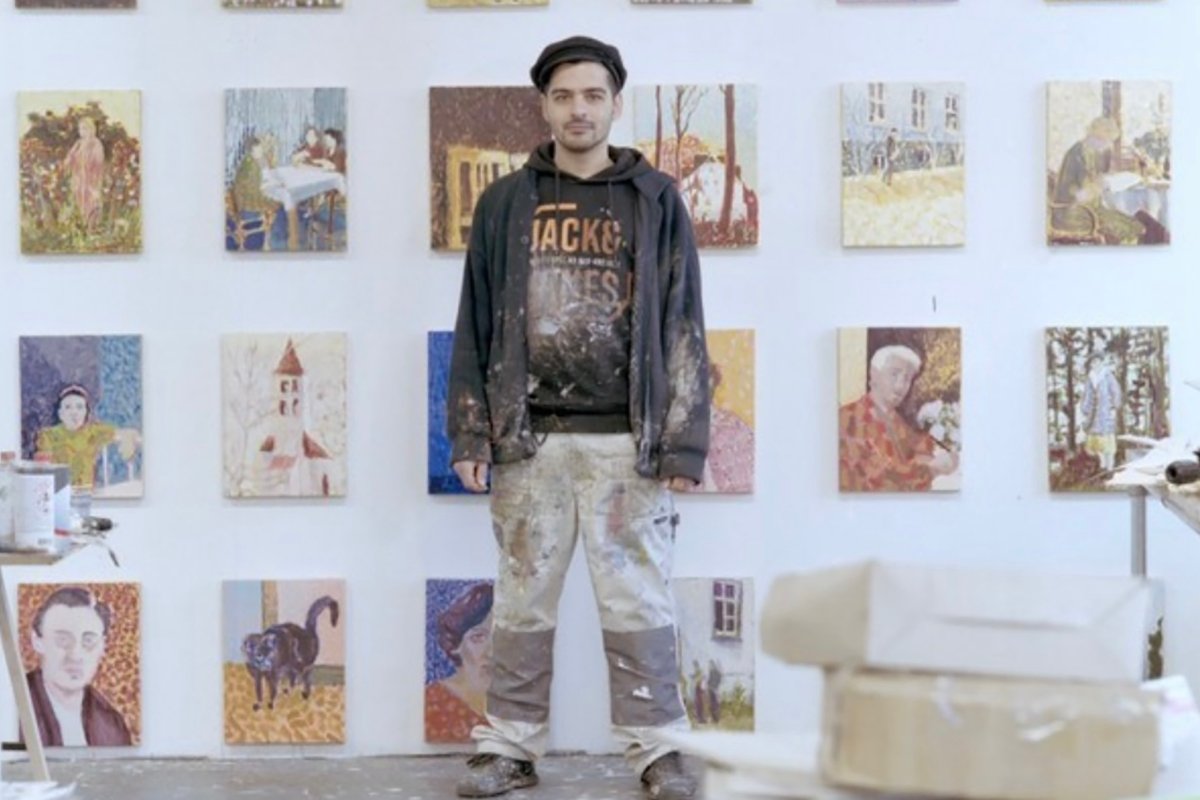
Danja Akulin Captured In His Studio, Surrounded By His Immersive Graphite And Charcoal Masterpieces
Innovative Techniques In Graphite And Charcoal
Danja Akulin discusses his journey from Leningrad to Berlin, his inspirations, unique techniques with graphite/charcoal, and how his stunning works explore light, shadow, and human connections through ambiguity.
D anja Akulin’s work redefines the art of drawing, elevating it to an autonomous and profoundly impactful form of expression. Born in Leningrad and now based in Berlin, Akulin’s journey has been shaped by the unique light of St. Petersburg and the guidance of renowned mentors like Georg Baselitz and Daniel Richter. His meticulous use of graphite and charcoal, combined with his innovative technique of mounting paper onto canvas, allows his works to transcend traditional boundaries, creating immersive, tactile experiences that command both visual and emotional engagement.
With exhibitions spanning Europe and the United States and recognition from institutions like the Elizabeth Greenshields Foundation, Akulin’s artistry strikes a delicate balance between technical mastery and philosophical depth. His exploration of the liminal spaces between light and shadow, particularly in his acclaimed “Penumbra” series, invites viewers to slow down, reflect, and inhabit moments of ambiguity.
Danja Akulin masterfully transforms drawing into an independent, evocative art form, blending technical skill with profound reflective storytelling.
In this thoughtful interview, Akulin shares insights into his creative vision, influences, and the deeply personal journey that informs his art, offering readers an intimate look at one of today’s most compelling contemporary artists. WOWwART Magazine is proud to showcase this conversation with an artist who epitomizes authenticity and innovation in modern drawing.
How did your upbringing in St. Petersburg and your father’s influence shape your early artistic journey?
My childhood was steeped in artistic practice – my father holds the title of Honored Artist of the USSR, which meant our household operated according to a particular rhythm. Initially, I’ll admit, my attendance at art schools felt obligatory rather than passionate. Yet looking back, I understand how profoundly those early years established my visual vocabulary, even when I couldn’t articulate it.
St. Petersburg’s luminous peculiarity – those extraordinary white nights, the extended grey seasons – became my first teachers in understanding how radically light can reimagine what seems mundane. The city itself functions as a study in chiaroscuro.
How did studying under Georg Baselitz and Daniel Richter influence your style and philosophy?
Berlin represented a turning point. Gaining admission to the University of the Arts seemed nearly impossible given the competition – hundreds competing for each position. What proved transformative wasn’t merely technical instruction but the philosophical approach. Baselitz possessed this remarkable capacity for identifying each student’s inherent visual logic rather than imposing his own aesthetic framework. He recognized that one’s origins – cultural, geographical – aren’t obstacles to overcome but essential elements to develop.
The pedagogical structure itself differed fundamentally: each studio became its own world. This validated my conviction that drawing could exist as autonomous practice. Both mentors demonstrated how technical virtuosity must always serve conceptual necessity, never the inverse.
Why monochrome, and how do graphite and charcoal communicate your vision?
This understanding emerged through considerable experimentation across media – sculpture, painting, various approaches. The realization arrived gradually: the pencil’s capacity for articulation exceeds what I could achieve with pigment and brush. Each mark’s pressure variation, every tonal gradation carries semantic weight that color would actually diminish.
Removing chromatic information doesn’t distance me from reality – paradoxically, it intensifies that connection. I’ve tested incorporating color repeatedly; it invariably feels extraneous. The textural accumulation of marks functions as my expressive foundation – analogous to how colorists employ their palettes. These accumulations possess actual visual mass; often the negative spaces achieve greater material presence than the ostensible subjects.
What draws you to “Penumbra” — the space between light and shadow?
The Latin etymology, paene umbra, nearly shadow, captures something fundamental about perceptual experience. This intermediate zone defies binary classification: one cannot definitively state whether penumbral phenomena are illuminated or obscured. This fundamental ambiguity feels more truthful than certainty.
Perhaps my attraction to this concept reflects personal experience – existing between Russian formation and German artistic maturation, never entirely belonging to either context. The most compelling truths inhabit exactly these uncertain territories. I’ve never found stark contrasts particularly interesting; existence unfolds in gradations, in transitional states where categories dissolve.
Walk us through your creative process. How do you decide when a work is complete?
Inspiration isn’t a lightning strike but continuous attention. Photographic images, natural phenomena, conversational fragments, momentary light conditions – these accumulate constantly, generating possibilities. Once something crystallizes conceptually, I begin exploratory drawings on paper, establishing compositional architecture and tonal relationships. For substantial works, this becomes protracted, layered development before mounting paper to canvas support.
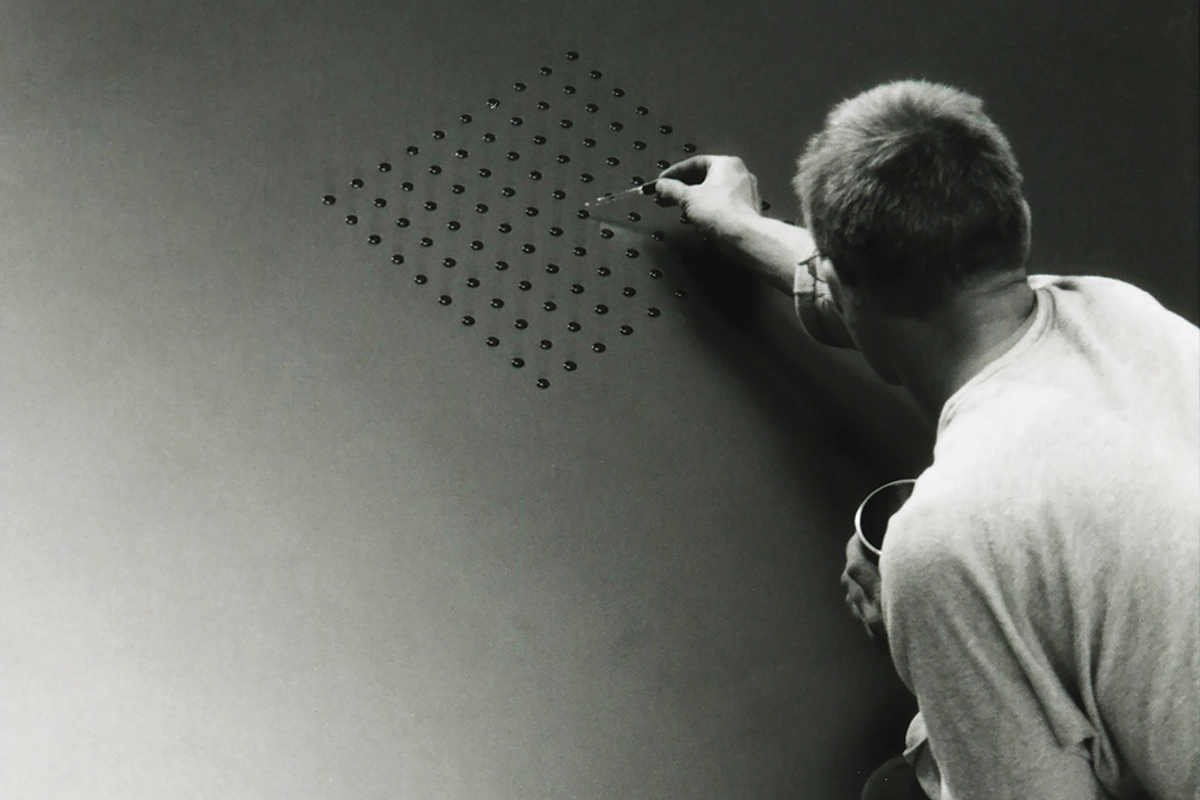
The process demands both meditative focus and physical endurance. Pieces at two-by-three-meter scale may develop over months. Completion announces itself intuitively – there’s a perceptible shift when the surface achieves its own presence, when spatial voids feel as substantial as depicted elements. The work begins asserting its own viewing requirements, and at that threshold, my intervention should cease.
How does scale impact your work’s emotional or conceptual power?
Dimensional choices prove inseparable from conceptual content. Certain ideas require intimate scale; others demand commanding physical presence. Large works fundamentally restructure the viewer’s relationship with the work. You cannot apprehend them instantaneously – they necessitate choreographed engagement, alternating between distance for comprehension and proximity for textural appreciation.
Monumental scale enables atmospheric immersion rather than mere depiction. The work can establish an environmental condition, an experiential field rather than simply an image to observe.
How might your technique evolve in the next decade?
My practice centered exclusively on pencil until 2010, when introducing charcoal and graphite – specifically employing brush application with these materials – generated new spatial possibilities. Developing the paper-mounting technique required years of problem-solving, but eliminated glazing requirements, preserving direct material engagement.
Future evolution remains genuinely open. Currently, graphite and charcoal feel irreplaceable for what I’m investigating. But authentic practice demands receptivity to change. The constant is commitment to drawing as primary cognitive mode, not supplementary activity.
What do you hope viewers take away from experiencing your art?
While drawing, time loses its usual constraints – stops, dilates, becomes malleable. I hope viewers encounter something analogous: suspension of conventional time-consciousness. The essential goal is making viewers pause and slow down, to engage sustained attention in the present experience.
Beneath visible mark-making, associations emerge in layers – sometimes spontaneous, sometimes deliberately structured. I don’t require specific interpretive understanding, I want visceral experienceI, sensation of accumulated material presence, recognition of fundamental ambiguity, momentary inhabitation of that in-between space where meaning is still forming.
How do you balance creativity with challenges of the contemporary art world?
For me, artistic identity constitutes an entire worldview, not professional designation. Many engage art-making without becoming artists because they approach it as a career rather than genuine commitment. Everything matters for serious artists – what you read, with whom you engage, how you structure attention.
Contemporary systems increasingly reconfigure artists as entrepreneurial entities with extensive teams. I maintain different priorities: work integrity, practice authenticity. I collaborate with galleries understanding this orientation, without pressure toward brand development. Reception tends toward polarization – strong resonance or complete indifference – which actually proves liberating. Attempting universal appeal would compromise everything.
10. What advice for emerging artists navigating today’s art ecosystem?
Challenge institutional constraints that inhibit development. I departed art school prematurely, feeling the institution had exhausted its utility – presumptuous perhaps, but ultimately correct for my trajectory.
Many misconceive artistic practice as an acquirable profession. It’s fundamentally an existential orientation. Everything nourishes the work. Expect sustained experimentation, perpetual searching. This required years and willingness to abandon seemingly viable approaches.
Context matters profoundly. Seek elsewhere if current circumstances constrain growth, while recognizing what remains valuable in your origins. Develop a distinctive visual language and master articulate communication through it. Technical facility remains crucial, but it must serve your unique vision.
The path proves demanding, frequently precarious. But if making art feels as necessary as breathing, full commitment becomes the only real option.