




Eric Tillinghast Creates Transformative Water-Based Art That Engages Space And Culture
Exploring Water, Light, And Site-Specific Installations
Eric Tillinghast transforms water into immersive, site-specific art, exploring cultural identity, natural landscapes, and light. His technical mastery and innovative approach create universally resonant, contemplative experiences.
E ric Tillinghast stands as a singular voice in contemporary art, transforming one of the most elemental forces—water—into a medium of poetic, structural, and cultural resonance. With a practice that bridges sculpture, installation, and environmental perception, Tillinghast challenges not only how art is made, but how it is experienced. His work does not simply occupy space; it activates it, inviting viewers into a dialogue shaped by memory, geography, and the ever-shifting nature of light and reflection.
From early influences rooted in the vast, meditative landscapes of Northern California to his technical mastery forged through industrial welding, Tillinghast has cultivated a practice that is both deeply personal and universally evocative. His installations—often monumental, always immersive—reveal an artist who is as attentive to the subtleties of human perception as he is to the rigor of construction. Whether exhibited in major institutions or realized as public works across cities, his art consistently dissolves boundaries between the natural and the built environment.
What distinguishes Tillinghast most profoundly is his ability to harness water not just as material, but as meaning. In his hands, water becomes a vessel for cultural identity, collective memory, and emotional reflection. Each installation becomes a site-specific conversation—one that shifts with the viewer, the light, and the cultural context in which it exists.
In this conversation with WOWwART, Tillinghast offers rare insight into the evolution of his practice, the technical and conceptual challenges behind his large-scale works, and the enduring inspiration he draws from nature. His voice is as thoughtful and fluid as his medium—revealing an artist deeply committed to exploring the intersections of place, perception, and possibility.
Tillinghast is a visionary artist whose ingenuity and mastery turn water into breathtaking, thought-provoking installations that transform every space he touches.
Interview Highlights:
- Childhood in Mt. Shasta inspired his fascination with water.
- Water as central medium connecting sculpture, memory, and cultural perception.
- Studied Industrial Welding to master structural forms for his work.
- Site-specific installations begin with analyzing architecture and natural light.
- Public artworks require collaboration with cities, architects, and engineers.
- Work is internationally exhibited, with cultural context affecting audience reception.
How has your upbringing in Los Angeles influenced your artistic practice and the themes you explore in your work?
I was born in Los Angeles, and live there presently, but I actually grew up in Northern California in a place called Mt. Shasta. This is a rural part of California with lots of wide-open spaces, mountains, and water. I believe that spending a lot of time around lakes and rivers during my childhood influenced my art significantly and is probably the reason that this element of nature became so central to my work as an artist.
“Spending time around lakes and rivers during my childhood influenced my art significantly.”
– Eric Tillinghast
Can you describe the significance of water in your art and how it relates to cultural identity?
My work with water started a result of being very enchanted with sculpture but not interested in any of its’ traditional materials. These artworks began as a way of sculpting with water and have gradually evolved into various artistic formats that are also about water. Making an object or an installation “out of” water can greatly alter peoples’ associations with it, often invoking personal memories and experiences. Each viewer’s unique cultural and geographic background influences their perception of what my work is about, and I am always curious to hear these various observations.
“Each community has a completely unique relationship with water.”
– Eric Tillinghast
What inspired you to study Industrial Welding, and how does that technical background inform your artistic creations?
After beginning to work with sculpture and make three dimensional artworks I quickly realized that fabricated metals were the best fit for the forms and structures I was interested in making. Studying under a formal welding program seemed like the best way to get proficient at building these forms as well as a way to ensure that I could always be capable of making my own work.
Your work has been exhibited internationally. How do different cultural contexts impact the way your work is received?
I have found that each and every community has a completely unique relationship with water. Whether it exists as a vital resource, a force of nature, or anything in between, every region has a communal understanding of water directly means to them. Cultural context can also greatly affect how the work is perceived and every area’s history, mythology, and religious beliefs regarding water often influence what the viewer sees. This work tends to provoke a wide range of responses from place to place, and sometimes a very different experience of the same works of art.
What role do site-specific installations play in your artistic process, and how do you choose the locations for these projects?
Building site specific installations is by far my favorite approach to art making. The process for developing these works is almost the opposite of any traditional studio practice wherein you build an object and then transport it to another location to be exhibited. For these artworks I start with the space itself and all of the characteristics of the architecture that will affect the appearance and experience of the installation. As my primary material is namely water, this process usually amounts to creating an inventory of how the sunlight behaves throughout the day and how reflective surfaces will respond as one moves through the space. Because of this the primary factor in choosing locations is natural light and I am always on the lookout for architecture that will respond well to my inspirations.
Can you discuss any particular challenges or highlights you’ve encountered while working on public art projects?
Working on public art projects includes a number of challenges that are different from the ordinary artist’s practice. The biggest difference is probably the actual process of developing a final work of art that meets both the needs and approvals of the client, the architecture firm, the engineers, and the city’s inspection needs. This can be a long and complicated process that sometimes goes on for years before the construction begins. The advantage to working in this manner is that it allows for the creation of works that would be impossible to create in the studio due to scale, site, and budget.
Editor’s Note
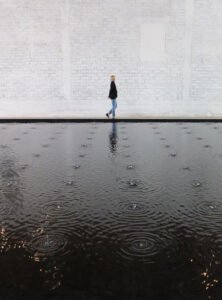
In this breathtaking installation, Eric Tillinghast transforms a minimalist industrial space into a meditative sanctuary. By masterfully manipulating water, a medium as volatile as it is serene, he creates a rhythmic field of ripples that feels both engineered and organic. The contrast between the cold, white brick and the dark, pulsing basin is sublime. Tillinghast doesn’t just sculpt with water; he captures the very essence of light and motion.