Panos Kokkinias, visionary artist and master of staged photography, captures timeless narratives that blend human fragility with cosmic vastness.
Existential Themes, Staged Precision, And The Art Of Visual Storytelling
Panos Kokkinias discusses his transition from straight to staged photography, his existential themes, creative process, inspirations, and evolving artistry, offering insightful reflections on humanity, isolation, and the future of his work.
P anos Kokkinias is a masterful artist whose work transcends the boundaries of photography, merging it seamlessly with elements of cinematography, psychology, and visual storytelling. A true global force, Kokkinias has not only exhibited his art across continents but has also carved a distinctive space for himself in the contemporary art world. His photographs, meticulously staged and soaked with existential nuance, challenge the viewer to grapple with profound questions about isolation, perception, and what it means to exist in this vast and untamed cosmos. Each frame is a world unto itself—a carefully orchestrated intersection of reality and imagination that pulls you in with its arresting beauty and leaves you contemplating the weight of its deeper truths.
As someone who has drawn inspiration from literature, painting, and cinema, Kokkinias offers a visionary approach to photography that defies conventions. Through his staged compositions, he constructs not just images, but visual narratives brimming with emotional resonance and intellectual complexity. His ability to seamlessly blend human figures into sprawling landscapes evokes a “God’s-eye perspective,” where the grandness of the world contrasts with humanity’s fragility. At the same time, he does not shy away from engaging with themes reflecting our modern condition—alienation, the chaos of urban life, and even the pressing environmental crises that affect all life on Earth.
We are honored to showcase Panos Kokkinias’ creative journey in this edition of WOWwART. As you delve into the conversation that follows, you’ll gain rare insights into the mind of an artist who not only crafts exceptional imagery, but through his art, poses pressing questions about our shared humanity and the world we cohabit. Kokkinias’ work is nothing short of extraordinary—an invitation to rethink the role of photography as a medium of truth, imagination, and profound expression.
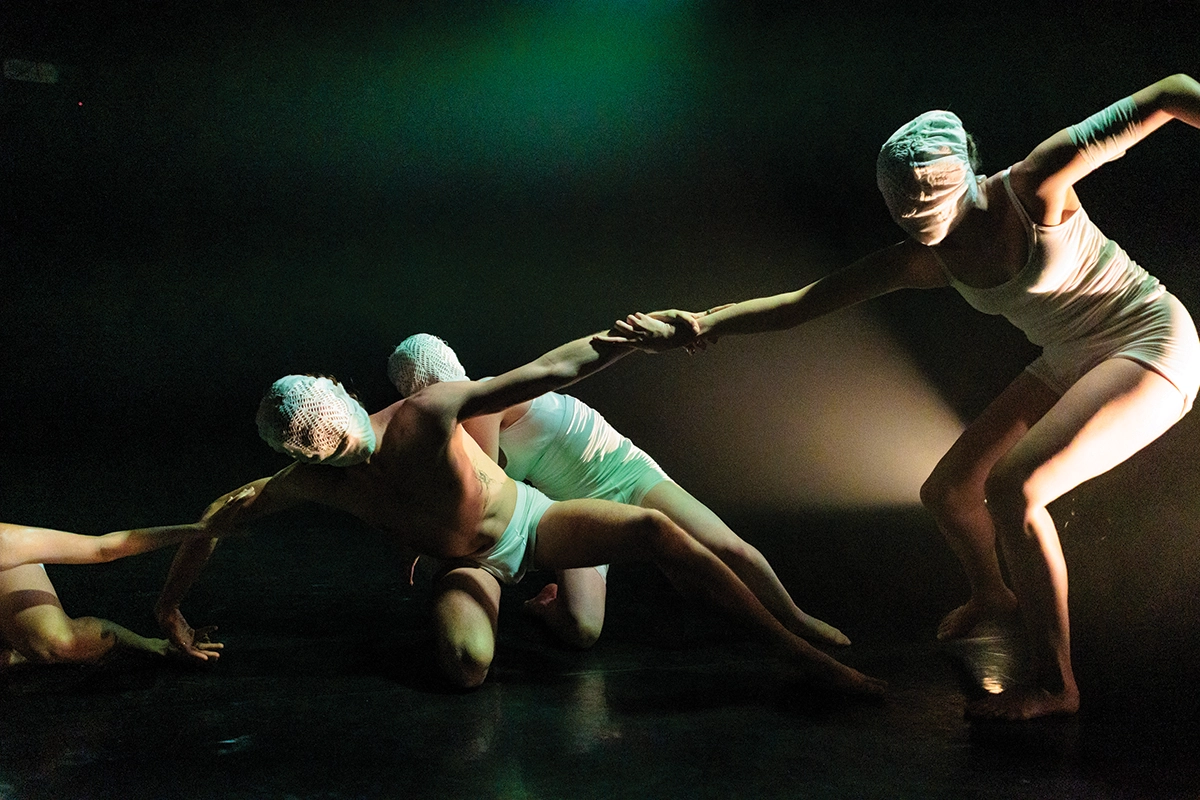
Panos Kokkinias masterfully combines photography and storytelling, creating visually stunning works that explore profound themes of existence and humanity.
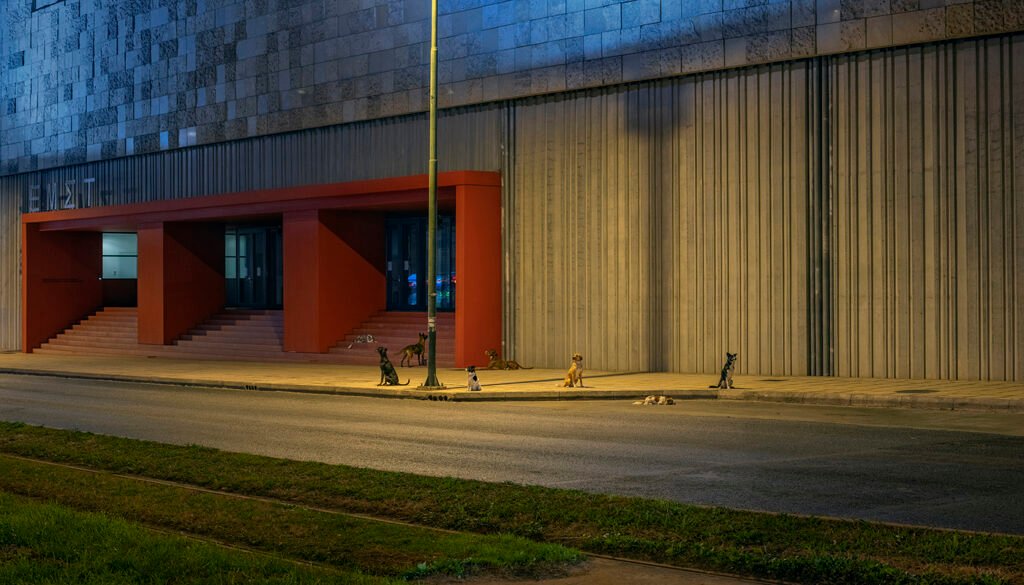
This striking photograph by Panos Kokkinias captures serene urban isolation. Stray dogs rest beneath warm streetlights, contrasting against a modern geometric building, evoking quiet contemplation and humanity’s coexistence with desolate spaces.
What initially inspired you to pursue photography as a career, and how did your early experiences shape your artistic vision?
My interest in art began with literature, which eventually led me to visual storytelling—filmmaking. I started studying various aspects of cinema, especially cinematography. Through that process, I discovered that still photography was a powerful tool for self-expression, one that required no funding, production, or crew. A few years later, I transitioned from straight to staged photography, essentially bringing filmmaking practices into photography.
Your photographs are often meticulously staged. What led you to embrace this directorial approach, and how does it differ from your earlier “straight”photographic work?
After years of walking the streets daily, trying to align my interests with whatever reality happened to offer, I grew tired of the process. People became increasingly camera-aware, making it difficult to point a lens at them; you were no longer the eccentric stranger taking photos for some mysterious reason. Suspicion replaced curiosity. But I needed people in my images. So rather than hoping to stumble upon something compelling around the next corner, I decided to create the scenes and situations I wanted to address in my work.
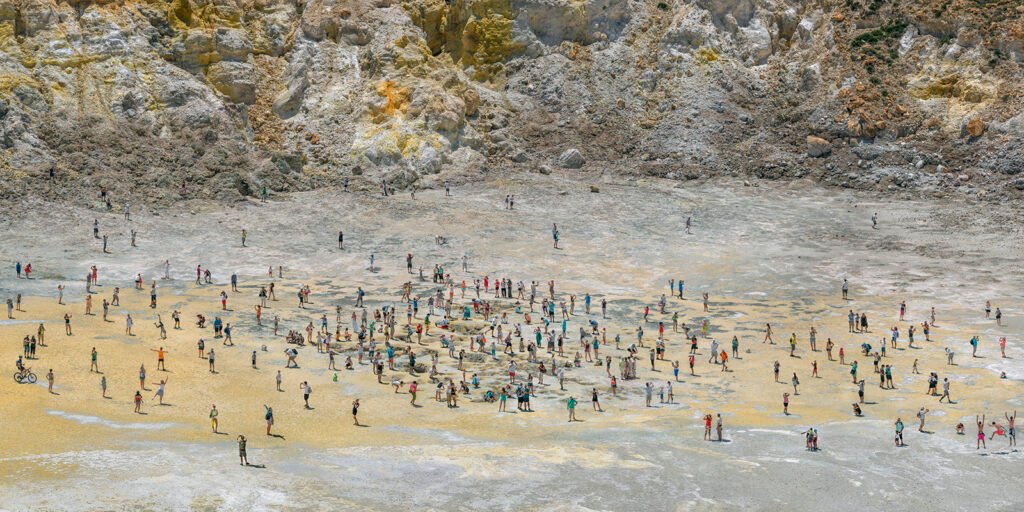
Panos Kokkinias transforms the barren, volcanic landscape of Nisyros into a mesmerizing tableau where human curiosity meets nature’s compelling vastness. His photo radiates exploration, capturing fleeting interaction within a seemingly timeless scene.
Many of your works are imbued with existential uneasiness, isolation, or ambiguity. How do you approach visualizing such intangible, abstract emotions?
When I first began staging my work, themes and ideas emerged almost automatically, as if surfacing straight from the subconscious. They reflected my own inner landscape and psychological needs. As I’ve grown older, both the subjects and the approach have become more deliberate—a rational, almost problem-solving practice. It now resembles directing a film sequence, except one designed to exist for only a brief moment.
In your opinion, should photography reflect reality or construct its own version of it? How do these perspectives affect your creative process?
There are no “shoulds” anymore. The indexical nature of photography—once central to its ontology—can no longer solely sustain the representation of the real. The imprint of reality is still there, but whether it is captured or constructed is no longer the point. You can produce documentary photography and still lie, or create fiction and tell a truth.
Which artists, writers, filmmakers, or thinkers have influenced your work, and how have their ideas shaped your approach to art?
Fyodor Dostoevsky and Albert Camus gave me my first clear articulations of existential unease. Painter Edward Hopper and filmmaker Wim Wenders deeply influenced how I think about the structure and atmosphere of the frame. The existential weight of Josef Koudelka and the staged truths of Philip-Lorca diCorcia were major photographic touchstones.
Your work blends elements of photography, cinematography, and even digital manipulation. Could you walk us through your process, from conceptualization to execution?
My process varies depending on the needs of each image. Sometimes it’s just a spontaneous moment—the “fertilization” of a pregnant landscape by a single human figure. Other times it involves combining straight and staged photography within one frame. Recently, my productions have grown more complex: months of preparation, location scouting, securing permissions, gathering costumes and props, and rehearsing with “actors”.
Many of your photographs place small, sometimes isolated human figures within vast or desolate settings. What draws you to this particular composition, and what do you hope to communicate through it?
I’m trying to view humanity from afar, from a kind of God’s-eye perspective—small and insignificant within the vastness of the cosmos. I want to present the bigger picture of what it means to be here and now, to visualize those rare moments when we actually feel ourselves exist.
Your work has been included in significant collections across the globe. How do you feel about your art being viewed in such institutional contexts?
It is, of course, a kind of reward and an encouragement to continue. But, for me at least, what matters even more are the moments when peers—other artists—recognize what you’ve achieved in a new image, when they reassure you that yes, it’s there.
How does the city of Athens inspire your work, and have your experiences there influenced the themes of alienation, transit, and estrangement in your photographs?
I experienced alienation and estrangement far more intensely during the years I lived in the U.S., especially in New York. Athens today is also a large, chaotic city—a constant transit space not only for tourists but for its own residents. It has become a fairly typical urban environment where the consequences of late capitalism are visible in everyday life.
What direction do you envision for your art in the future? Are there any new themes, techniques, or concepts you’d like to explore?
Lately, I’ve grown increasingly interested in animals—how they perceive the world, how they experience the shrinking of their habitats, how they suffer from climate change, and, above all, how they suffer because of us. But staging photographs with animals is difficult, so I’m currently looking for solutions. It might mean returning to straight photography, moving forward with AI, or perhaps finding a way to combine both.